
web analytics

Holidays in the Hospital

November 16, 2011 in From the Hospital, Insider Insight by Children's Healthcare of Atlanta

By Ginger Tuminello

Child Life Specialist for Heart, Kidney and Liver Transplant Patients at Children’s Healthcare of Atlanta

The holidays can be stressful, especially if your child is in the hospital. Here are some tips on making the holidays in the hospital a little more bearable.

Acknowledge your feelings and the feelings of your child.

Being in the hospital, especially over the holidays, stinks. Recognize those feelings and say them out loud to your child. Once you’ve established that you’re both sad/upset/frustrated, focus on the things that can make being in the hospital over the holidays better. Just think, one day you may be telling stories that start, “Remember that Thanksgiving we spent in the hospital and had to eat turkey from the cafeteria…”

Continue established family traditions, or some variation of them.

As a family, identify what family traditions are most important to you and find ways to continue them. If your family always goes to church on Christmas morning, find out if the hospital chapel is having a service. If you always make holiday cookies, try making holiday ornaments instead. If your child’s favorite Thanksgiving treat is pumpkin pie, have someone make and bring it to her (if dietary restrictions allow). Or simply postpone Thanksgiving dinner until your child is feeling better and out of the hospital. There are no rules that say you must eat Thanksgiving dinner on Thanksgiving.

Create new family traditions.

Talk to your family about starting new holiday traditions. Make holiday ornaments to put on the hospital tree. Plan a holiday game night using either board games you love or finding new holiday games to play (check out http://www.coolest-christmas-holidays.com for some ideas). Make small gifts for the nursing staff. Organize a toy drive or fundraiser for hospital or organization. Your hospitalized child could always help design a flyer and plan other details.

Find out about special events and visitors offered by the hospital.

During the holidays, lots of folks enjoy volunteering and putting on special events for the hospital. Even though the local nursing home group playing hand bells may not sound very exciting, you might be surprised. Think of these events as opportunities to get out of the room, socialize, and make new holiday memories.

Start a special project with your child.

Take pictures and create a holiday scrapbook. Make holiday cards for other patients. Make gifts for family members. There are lots of inexpensive craft projects that you could do with your child that would provide hours of entertainment and bring a smile to many faces. Check out www.familyfun.com or www.craftbits.com for some great ideas.

Decorate.

Nothing says holidays like decorations. Bring a holiday blanket and pillowcases from home. Create holiday pictures and hang them on the walls. Get a small fake tree, decorate it, and put it on display. Get washable window paint and paint your windows. Wear festive clothing. If the room looks festive, you may find yourself in the holiday spirit. Just be sure to check with the hospital staff about policies regarding lights, hanging pictures, live plants/flowers, and window painting. And don’t forget to bring pictures of your loved ones at home.

Plan one small thing to look forward to each day.

The trouble with being in the hospital is that it gets boring and redundant. Plan something each day that you and your child can look forward to. Pick out an interesting location (i.e., gift shop, outdoor garden area) and plan for an afternoon walk there. Rent or borrow a new movie and plan for a movie night. Borrow a game you’ve never played and have a game night.

Create a schedule for visitors.

Hospital rooms can be tight quarters and too many visitors at once can be overwhelming. Creating a schedule for visitors can help limit the number of visitors and also allow you to schedule some quiet/alone time, which is important.

Find out the visitor policies.

During cold and flu season, some hospitals don’t allow siblings to visit. Find out these policies and ways to work around them. Is there a common area that the siblings can come to, like the cafeteria, so that you have time as a family? Could you use technology like Skype to communicate when you can’t be together? Try playing a game using Skype, making sure there’s a board on each end. Have your children at home and your hospitalized child write letters, send pictures, or record messages/stories often. Getting mail or email can really light up someone’s day.

Make time for yourself.

If someone offers to play with your child so that you can take a break, let them! Go for a walk, get a cup of coffee, or take a shower. Make sure that you are taking time to decompress and focus on yourself.

Use your team.

Your child life specialist, social worker, and chaplain are all great resources to help you and your family cope with hospitalized holidays. Be sure to let them know when you need something or just need to talk. They can be a great source of comfort and support.

Special needs met in a special place

November 4, 2010 in Special Needs News by Admin Dawn

Several decades ago, five lots of city land on McKercher Drive were donated to the Presbyterian Church in Canada by the McKercher family, long-time members of St. Andrew’s Presbyterian Church. A plan was eventually put together to develop a ministry in the College Park area and McKercher Drive Presbyterian Church was established. The congregation grew to several hundred with a thriving Sunday School and three Sunday services.

However, the dynamics changed over the years. People moved away; members aged. Last year the decision was made to amalgamate with St. Andrew’s Presbyterian and sell the building on McKercher Drive.

The church facility was sold to Light of the Prairies, an organization that works with mentally challenged individuals and provides specific programming for those with complex needs.

via Special needs met in a special place.

Everyone can relax during mass for kids with special needs

October 7, 2010 in Special Needs News by Admin Dawn

Lindsey Emory’s big brother Bryant sometimes acts a little differently from other children during Mass.

He might see something that grabs his attention and stare. He might hear a song he likes and start dancing in his pew.

And occasionally, when Bryant, 12, who is autistic, behaves that way during church, people stare.

That doesn’t happen, however, at the Special Needs Ministry Mass at St. Luke Parish in Long Valley, Lindsey said.

“(The Mass) makes me feel happy, not just for me, but for Bryant, too,” said 9-year-old Lindsey. The shortened Mass, held once a month, helps Bryant “learn how Mass works,” she said.

“The special-needs Mass makes Bryant very happy, and I think he thinks that he fits in well, and he has a lot of fun there, and he really doesn’t ever want to leave,” she said.

St. Luke Parish in Long Valley is one of area several houses of worship that have created worship services catering to members of their religious communities who have special needs. The emphasis, in most cases, are the littlest members and the families that worship with them.

Read more here: Everyone can relax during mass for kids with special needs in Long Valley, NJ | dailyrecord.com | Daily Record.

Ready, set, read! Meet Barb, our book club moderator

August 31, 2010 in Featured Group, Featured Member by Admin Dawn

Special Needs Book ClubSince our book club is just gearing up this month we thought we’d interview member Barb who has spearheaded the whole campaign. A wife and mother, Barb not only helps out at Support for Special Needs, she also runs a ministry for families parenting kids with special needs.

Can you tell us about your personal interest in supporting families with special needs children?

My interest in supporting parents with children who have special needs really began when our son was 2 years old. Diagnosed at birth with Severe Hemophilia A, a bleeding disorder, we found that our faith life had everything to do with how we were surviving daily life with his diagnosis. There really wasn’t anything out there for parents. We also found that we had much in common with families whose children had different diagnoses than ours.

Can you tell us about Snappin’ Ministries — what your purpose is and how it got started?

We really wanted to be served and cared for, but after attending a Bible study by Henry Blackaby called EXPERIENCING GOD, it was obvious that we were being called to do the serving. We knew next to nothing, but I will contend that this what exactly what God wanted so we wouldn’t get in His way. In 2002 we began a small group with monthly meetings through our supportive church with the intent of moving beyond the four walls in time.

There is such a need that things moved much faster than we ever could have imagined. In 2007, we incorporated as a free-standing 501(c)(3) non-profit with the mission statement: Our pursuit is to continuously support and encourage those living with the daily challenge of parenting a child with special needs so that the genuine love and hope of Jesus will be experienced and shared in their everyday lives.

We minister to parents of EVERY parent of a child with special needs regardless of religious affiliation or beliefs. Of course, we would like to share the hope that we have, but that doesn’t impede our service. We aim to love as Jesus loved. You can learn more about us and find extremely helpful resources, an event calendar, links to our blog and other social media at our website http://snappin.org. Of course, you can always make a donation via PayPal on our homepage as well, which is essential to keeping our work going.

Besides the online tools we offer parents, we also send our signature gift baskets for moms and dads all around the country, offer self-published books and support parents through hospitalizations or financial difficulties with our gift card program.

What was your inspiration for starting the book club?

I was already facilitating the Faith & Disabilities Group here. I am a voracious reader and find that reading fillls my soul whether it be on special needs topics or just for fun. I sought to start a book club within our group, but so much of what I read is not merely limited to issues of faith. I thought it would be really helpful to open a book club forum up to all of those who participate in the website. Besides that, parents of kids with special needs so often don’t have the time available to participate in local book clubs in their community. This venue would offer these terrific parents a delight that they would otherwise not have because of their parenting circumstances.

How will the book club work in a practical way? How can people join?

In a practical way, this book club will be even more user friendly to parents who have a child with a special need. We will move at a slower pace than typical book clubs, reading one book per month. The selections will alternate between fiction and non-fiction. And the participants can post comments for discussion at their leisure with a final live-chat at the end of each month regarding the book. We are hoping to choose books that a parent can obtain through a local library so that it will save parents money too. To participate, parents only need follow us at the Support for Special Needs’ Group.

Do you have future plans for the book club?

As far as future plans for the book club go, we all know that flexibility is key in parenting a child with special needs. The book club will be no different. Since it is so new, we will definitely be open to adaptation as things become more apparent to us. We would love for those interested to be willing to share their personal reviews of books or their “bookshelves” on GoodReads.com or LivingSocialBooks if they feel comfortable. Word of mouth can and often is the way many of us find our favorite books!

Queer Parenting on the Spectrum

August 17, 2010 in Inspiration by Admin Dawn

Two moms and a kidI was into re-invention long before Madonna made it her trademark, identity-hopping every year or so like a lizard shedding her skin, which leaves me at forty-four strangely devoid of long-term friendships, but full of life experience. And with each skin came a community. In chronological order I’ve been: a Hollywood Hills six year-old schooling with privileged children prepping to be movie stars, an anxious American in British Columbia chumming up with other children of alcoholic fathers, a Seattle high school theater person holed up with the drama department during rehearsals, a bisexual band-aid dating my way through a pack of pot-head Jimi Hendrix wannabes, a radicalesbian feminist studying sexism alongside fellow Women’s Studies majors, a platform-dancing sex-radical sucking lattes with erotic dancers, Leather Dykes and fascinated college basketball players, one-half of a monogamous same-sex couple spending time with other same-sex couples attempting to stay together against the odds, then, a Portland, Oregon, stay-at-home mom to one, two, and eight years later, three kids surrounded by a supportive circle of lesbian moms.

Oh, and a writer, artist and Unitarian Universalist unsure about organized religion.

The parenting communities we belong to push arts and athletics, are left-leaning and liberal-minded, read Reviving Ophelia and Real Boys. They believe in no-hitting rules, reward systems, co-operative preschools and that good parenting makes for a well-behaved child. My new mothering path does NOT resemble that—our boy was tossed out of the co-op, the pre-K, and the summer swim program, reward systems and punishment alike meant nothing to him, and chatting at the playground (that sanity-saver for the at-home mom) was something that couldn’t happen when I had to be on high alert. By the time we had a name for it, I’d been held hostage by our son’s autism for years.

It’s hard to find or be in a community when you can’t see other people face to face with your kid around, or receive a phone call without getting assaulted, or spend much time online since you’re always preventing disasters. But one tries. I realized I needed other moms who “got it” about our kid, without judgment or harsh looks.

He’s six, now, and I’ve found my sub-culture: moms from his high-functioning K-2 class, his aide, and his two teachers. No, it isn’t a circle of post-co-op preschool parents, raising vegan, non-television watching kids, or a set of wholesome soccer moms, bringing rice crispy treats to the sidelines. Yes, these women understand. Even a few of our parenting pals with typical kids are starting to see it wasn’t just bad parenting.

We, my newfound posse of parents and specialists, can be relaxed together about these atypical, intelligent kids, ragging on them without having to extrapolate on the guilt involved; it’s fair game somehow to bitch about your kid’s potty-training challenges when he’s just a bit later than usual, but complaining that your four year-old is in diapers when he’s developmentally-delayed seems below the belt, so to speak. We know our job is to cheerlead, support, boost, but we must complain somewhere about how hard it can be, just like the other mothers, or burst. Together, we can riff on grocery store meltdowns, rant about the gawkers who didn’t make it easier, repeat frank comments our kid made about Uncle Bob’s belly that bring down the house, roll our eyes about broken windows, confess how our kid lost it and we cried all day, and discuss the possibility of needing tasers when our kids are teenagers, without feeling like the sickest mothers in town, or anyone involved questioning our love for our children.

The usual parenting paradigm does not apply, and we know it. For every kind of “typical” childrearing methods that proved useless if not harmful to our sensitive young, whether our own idea or urged on us by others, we are weighed down with remorse. For every misplaced effort (and lowering your standards seems key to survival), misspent money on therapies (but believing in a positive future is necessary for progress), and mistaken kinds of discipline before we knew better and that “a little more structure” wouldn’t make all the difference, we angst, beat ourselves up, and try again.

As a lesbian mom wishing for some visibility at the dawn of the gayby boom, back when pregnancy = straight, I often thought that a T-shirt was the answer, though at the time I really wasn’t cool with inviting strangers to stare at my chest. I’d had enough of that back in my platform-dancing days. Now, not only would I hand out business cards urging people not to remark on our son’s beeping, clicking and repetitive coughing, if I didn’t think our son might take it as a negative reflection on himself, but I’d happily wear a T-shirt that reads “I [heart] my [puzzle piece],” identifying myself as the proud parent of a child on the autism spectrum.

This skin, however, must co-exist with those beneath; I’m still a stay-at-home mom to two teens who set a high standard for behavior, discourse and sense of humor. I’m still one-half of a same-sex couple staying together despite the odds. I’m still a writer, an artist, and a reluctant church attendee. I will find my way back to those communities once I settle into my new one, surer of myself and my role in the world, and no longer alone.

Beren deMotier is a frequent contributor to Curve magazine, and has written for And Baby, Proud Parenting, and GLBTQ newspapers across the nation. Her award-winning book, The Brides of March: Memoir of a Same-Sex Marriage, was a Finalist for the 2008 Oregon Book Awards. You can find her at her blog The Lesbian Mom Next Door.

This piece originally appeared in hipmama magazine and we are eternally grateful to them and to Beren for allowing us to reprint it here!

Healing and Wholeness

August 5, 2010 in Faith by Admin Dawn

by Sue Boardman

In approximate chronological order, I am a woman, a mom, a nurse, a wife, a minister in the Presbyterian Church (USA), a counselor, a patient and, most recently and delightfully, a grandmother. It was intriguing to me that I had to move backwards, through all those layers of learning, rather like an archeologist might, to find the beginnings of my perspective on why children have disabilities. I think it began with a game.

You see, during all of my middle and high school years, I was sheltered and nurtured and challenged in a summer camp program. Funded by the Florida Association of Garden Clubs, it was run and staffed largely by a Presbyterian elder and a tribe of Presbyterian youth. We swam and canoed and sang Kum ba Yah, which, for the uninitiated means “Come by Here” around the campfire. There was a strong ecological emphasis in the program and it was there that I first learned to recycle and pick the litter out of the dustpan when it was our turn to sweep after dinner, that the actual dirt might be returned out doors. (I’m pretty sure it all got tracked back in the next day, but we were trying and this was the late 1960s!)

Every week, with each group of kids, we played the spider web game. Campers were each given a note card on which was written some participant in the local ecosystem, which, as I recall, was a long leaf pine and turkey oak community. The kids sat in a huge circle and tossed an enormous, grubby ball of string back and forth until each kid was holding a piece and it really did look like the world’s largest spider web. The task was to tell, each in turn, how the name written on your card was dependent on the name on the card the kid was holding at the other end of the string. You know the deal. How does the leaf depend on the rain? How does the ant depend on the camper? How does the sun depend on the ant?

You guessed it. It gets harder!

I think that’s when I first began to grasp just how dependent we all are on what I would claim is a divinely created system in which we are at the same time tremendously powerful and tremendously vulnerable.

These days there’s a fair amount of moderately out of date nursing knowledge stacked on top of that game. And a truckload of Greek and Hebrew and the elusive thing called theology. There’s some handy stuff known as hypnosis, some more current, or perhaps ancient, medical perspectives and an increasing stash of skill with soup stock and quilting and organic gardening.

You might say that I spend my days engaged in a lot of things I just don’t understand. Perhaps that’s why one of the names for God is mystery. There are probably a fair number of things I’ve gotten wrong and a lot more things for me to learn, especially on that day when I will see, as the apostle Paul would say, “face to face.” I just don’t believe that God gives babies disabilities. Or special needs. I don’t believe that God sends children with disabilities to specific parents to punish them or teach them a lesson or even because they’re somehow more likely to survive the experience. Kids are born with disabilities because sometimes the genetics go awry. They are born with disabilities because of tragic birth injuries, or environmental toxins, or side effects of medication. Sometimes they develop disabilities for many of the same reasons.

I do believe, with the Lutheran scholar, Terence Fretheim, that God suffers with us when our children are born with special needs. I believe God weeps over the world created good and the mess we’ve made out of it by our attempts to own and harness andcontrol whatever happens to be at the end of our particular string because it’s all connected and it all matters.

I also believe that God’s will is always for healing and for wholeness. And that the spark of God’s spirit in each of us sometimes flourishes and blooms and effects the world around it in ways we might never have imagined, given our usual notions of able or disabled.

As I write these words, literally, BP is announcing that oil is no longer spilling into the Gulf of Mexico but they don’t know if the cap will hold. It will be generations before the full impact of the spill is known. Some of them will clearly be children with more challenges than God would ever hope. And not all of those children will be pelicans or sea turtles.

Our job is to go on working for healing and wholeness right along with God. And to know that there is no place that God will not go with us.

Called to respond, to love and to see beauty

August 3, 2010 in Faith by Admin Dawn

Do you have a spiritual perspective on why children have disabilities? Does God choose particular children/parents?

No disability is good. Some are a result of our choosing to live without God. Genetic disabilities are different. John 9 tells about a man who was born blind. Jesus said his blindness was not the result wrong behavior (neither the parents nor the man himself.) Instead Jesus continues, “It happened.” I think genetic disabilities and natural disasters are similar. They happen. We live in a good but not a completed world. Good but not completely perfect children are born into our world.

I’m more certain of what God does for children with disabilities and their parents than I am why they happen. Jesus had compassion for, hung around and healed children (and adults) with disabilities, even some who were ungrateful.

I don’t believe God chooses particular children/ parents to endure horrible disabilities. I believe God does choose to work grace in all of us. As my favorite rock star theologian Bono says, “Grace travels outside of karma, Grace finds beauty in everything, Grace finds goodness in every thing, grace makes beauty out of ugly things. As a Wesleyan the final’ ugly to beauty grace’ will happen when we leave these bodies and are glorified.

We live in the world that already experiences God’s grace and has not yet received all that God has for us. Donald Miller likens this to receiving an invitation to the Wedding Feast but not yet sitting down at the table. So we are called to respond, to love those with disabilities, to try to see the beauty in everyone and to prepare for what is to come.

Steve Thomas is Pastor of Families at Harmony Grove United Methodist Church in Lilburn, GA Together with his wife Cheryl he has two children Geren and Glori. Geren is a Senior at Parkview High School and Glori is a Freshman. Steve has a Master’s of Divinity from Candler School of Theology, Emory University. Steve is blessed by grace each day but counts by far the most explicit experience of God’s grace as the day when his wife Cheryl was a living kidney donor for a young girl with ARPKD.

Moving

July 7, 2010 in From Julia by Julia Roberts

When my daughter Quinn was 4 months old she began therapy. Vision, OT, Speech and PT. It was a whirlwind of people in and our of our house. Something like 5 or 7 appointments a week? Include those with my son’s therapy appointments (outside of the home) and doctor appointments to manage failing kidneys and vision issues and we were a mess of appointments.

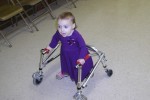
I know it seems a little early for therapy to start but our son, who was just over 2 1/2 when she was born, had multiple issues and she had the same diagnosis and was considered “high risk” by the team. She didn’t sit up until 8 months and pull up to stand until 13 months. When she was 14 months old it was time to discuss using a walker. When her physical therapist Karen mentioned it to me she also said a lot of parents resist the idea because it was a huge outward sign that something was “wrong” but she also felt it would help her connect with her peers, explore more (she was prone to just sitting there and letting people bring things to her) and that it was time.

I was all for it and after Quinn’s initial hatred of the walker she learned about it’s freedom and she never looked back. The first time she really had to use it and explore was during a birthday celebration for (grandfather) Pop, which was held in a fellowship hall of a small church. Once she came in and people got over their pity of seeing the poor crippled child (it was palpable) all they saw was a happy girl exploring her world. She was moving too fast to stop, weaving in and out of people like she’d never had the chance to do.

Kids were especially interested in the Girl on The Walker and could not keep their hands off. My girl didn’t mind it much except when they impeded her movement. She didn’t mind them hanging on, pushing, or touching it as long as she could be in motion. On times too numerous to count, I had to explain to kids (and a few adults) to give her room, to let go of the bars, release her.

I had to tell them that those were her legs. They were her way to see the world, stand up right, that they were her way to grow and connect with others just like her, just like them, the kids I was talking to and  yet, some kids didn’t get it because it was shiny and different. In many cases she enjoyed the attention it gave her and she welcomed kids to hang on to the back bar.

On a rare occasion, a mother would get mad because I was asking their kid (over and over) to let go of the walker because they were stopping it. I’d had to explain that I had to protect my daughter’s ability to walk and had to insist if their kid was stopping the walker from moving they couldn’t touch. When they would say something under their breath about “kids being kids” I’d have to say, sure, of course, but after several requests, they’d need to intervene with their child to help me protect my daughter’s right to be mobile.

It was the first time in her life she moved; she was active. The very least I could do was protect her hard fought mobility. It didn’t matter that other people thought something was “wrong” with her or that other mothers thought that Quinn getting any attention would outweigh her needs to be met and protected, what mattered was Quinn’s ability to move.

Watching her grow during the time from sitting still to moving was magical to witness. Once she took off, she never looked back. When I look at her I always think to myself, “Fly Quinn Fly.”

%d bloggers like this: